Estimated reading time: 8 minutes
Key Takeaways
- Summer camps are a strategic tool for sustainable student acquisition – from the first trial contact to permanent course bookings.
- Intensive training phases lead to faster learning progress and measurable success experiences within just a few days.
- Social experiences and team spirit increase loyalty to the tennis school and improve re-enrollment rates.
- Clear structures (daily schedules, groups, supervision) build trust with parents and enhance training quality.
- Targeted marketing via landing pages, social media, and partnerships maximizes local visibility.
Table of Contents
- Why a summer camp in the tennis school makes so much sense
- Social added value and fun in movement
- Recommendations and “Word of Mouth”
- 3. Concrete holiday program design for maximum appeal
- 4. Marketing the tennis school holiday program
- 5. Additional incentives for student acquisition
- 6. Success measurement and optimization
- Conclusion and call-to-action
- FAQ
Why a summer camp in the tennis school makes so much sense
A summer camp in the tennis school is much more than just a holiday program for modern tennis academies. It serves as a strategic tool to engage children and adolescents during their school break, enable intensive learning progress, and retain new members long-term in your tennis school. More information and inspiration can be found on the German Tennis Federation (DTB).
Those who plan and market their holiday program in the tennis school wisely can optimally utilize the high demand during the holiday season. Student acquisition through tennis camps works from the first trial contact to permanent course bookings.
“Our camp was fully booked, and 62% of the children booked a course immediately afterwards – intensity, fun, and clear follow-up offers work like a magnet.”
In this article, you will learn how to make your summer camp a magnet for new students with well-thought-out mechanisms, targeted program design, and effective marketing.
Targeted approach during the holidays
During the summer holidays, many tennis facilities are empty – this is your great opportunity. A holiday program in the tennis school not only brings the courts to life but also targets different groups:
- Existing members and their friends
- Vacationers and holiday guests from the region
- Non-members who want to try tennis
- Families looking for meaningful holiday care
The holiday period creates a natural framework for initial contacts with your tennis school.
Learning boost through intensive training phases in the summer camp
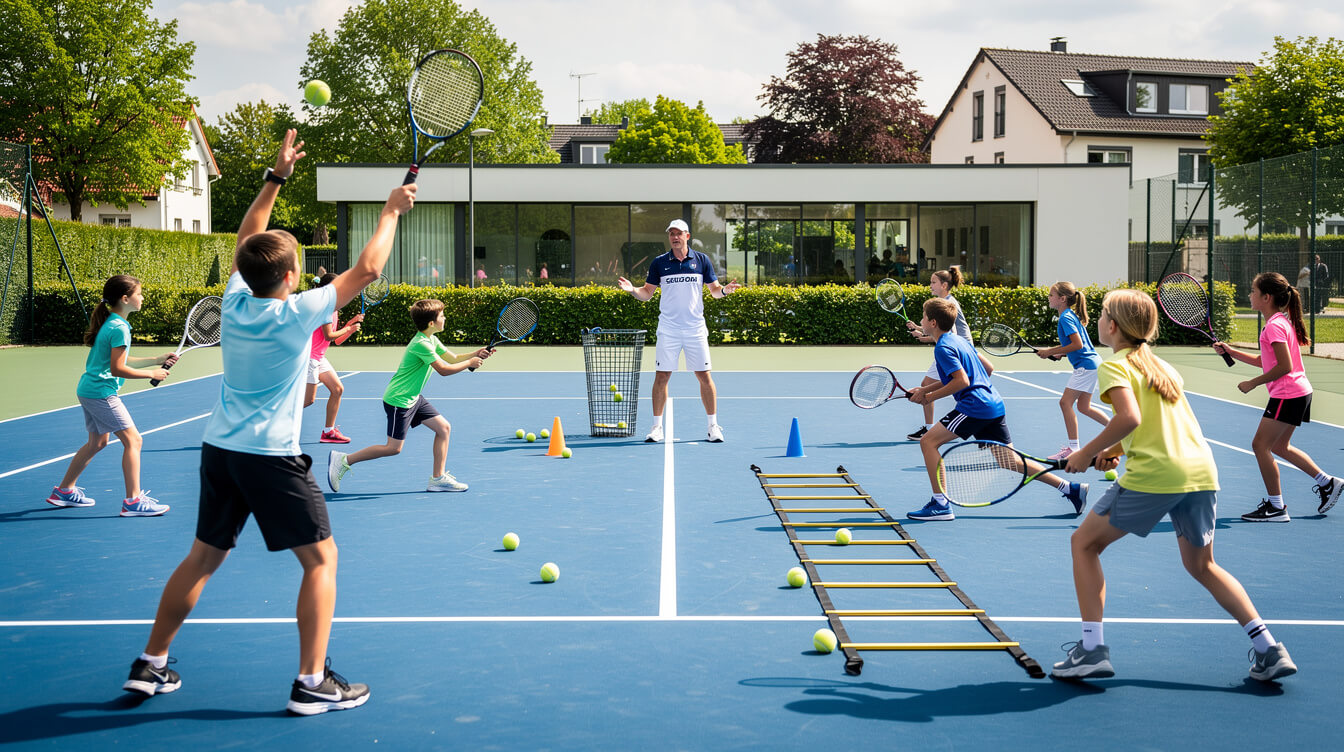
The biggest advantage of a summer camp lies in the training intensity. Several consecutive training days lead to significantly faster learning progress than a single weekly training session. The structured modules are often set up as follows:
- Technical training: Basic strokes, movement sequences, stroke variations
- Tactical training: Game understanding, positioning, strategy
- Coordination: Agility, reaction, balance
- Matchplay: Practical application of what has been learned
This way, children experience measurable improvements and real success experiences within just a few days – and directly associate these with your tennis school. The student acquisition through tennis camps benefits enormously from these visible progressions. Parents see the positive development leap and are more willing to continue training in the tennis school even after the summer camp.
Social added value and fun in movement
Team games, mini-tournaments, common lunches, and additional activities promote team spirit, new friendships, and a positive image of sport and movement. Practical tips for tournament organization can be found in the guide “Tennis School: Organizing Tournaments”. This enhances the emotional bond with the tennis school and increases the re-enrollment rate.
Recommendations and “Word of Mouth”
Enthusiastic children and satisfied parents share their experiences within their social circles, schools, and daycare centers. How to leverage events and small competitions for reach is also shown in the tournament guide for tennis schools. Local word-of-mouth is a central growth driver for a tennis school – especially when supported by a professional appearance and clearly communicated offers.
3. Concrete holiday program design for maximum appeal
A convincing tennis school holiday program requires clear structures, age-appropriate content, and a professional supervision concept.
- Weekly and daily plans
- Technical training (forehand, backhand, volley, smash, serve)
- Tactics and match play (scoring, game forms, tournament structure)
- Framework elements like children’s Olympics, obstacle courses, team games, closing tournament with award ceremony – ideas are provided in the guide for tournament organization
- Age and performance-related groups – Classification by age and skill level (e.g., 6–8 years, 9–12 years, beginners, advanced) allows for individual support and prevents over- or under-challenging. Small groups are crucial for training quality and safety.
- Supervision concept and safety standards
- Sufficiently qualified coaches with licenses and experience in working with children and youth.
- Clear supervision keys (e.g., max. 8 children per coach, closer for younger ones).
- Guidelines for meals, breaks, sun protection, and emergency management.
A clearly communicated daily schedule (e.g., training in the morning, matches & leisure in the afternoon) creates transparency and trust with parents.
4. Marketing the tennis school holiday program
For your tennis school summer camp to have an impact on student acquisition, it needs targeted, locally-oriented marketing.
- Landing page and SEO optimization – A dedicated camp page with keywords like “tennis school summer camp” and “tennis school holiday program” increases visibility. Also, use a well-maintained Google Business Profile for local searches.
- Transparent information: Dates, prices, target groups, daily schedule, coaching team
- Pictures/videos from previous camps
- Online registration form or clear contact options
- Social media campaigns – Instagram stories and reels, Facebook events/ads for local parents, and dynamic TikTok clips for youth.
- Cooperation with schools, sports clubs, and local media – Flyers, information evenings, cross-promotion with clubs. Present the tennis school summer camp in local media and portals. Practical ideas for local visibility can be found in “Marketing the Tennis School Locally”.
5. Additional incentives for student acquisition
- Early bird discounts and sibling discounts – Ensure planning security and increase family attractiveness.
- “Bring a Friend” actions and contests – Leverage referral power; prizes like camp T-shirts or a free camp spot increase reach.
- Trial weeks after the summer camp – For example, “4-week trial courses at a special price”; introduce follow-up levels (children’s courses, team training, talent promotion) already in the camp.
6. Success measurement and optimization
- Key metrics
- Number of registrations per camp period
- Ratio of members to non-members
- Rate of subsequent course bookings and memberships
- Re-enrollments in the following year
- Feedback from parents and children – Standardized online surveys or short questionnaires at the end of the camp provide valuable information on organization, training quality, supervision, catering, and additional activities. With permission, quotes can be used for marketing.
- Data-driven adjustments to the holiday program
- Expand popular elements (e.g., more match play, more additional activities)
- Rethink less demanded times/age groups/formats
- Optimize pricing structure and camp duration
Conclusion and call-to-action
Tennis school summer camps are an effective engine for sustainable student acquisition when programming, supervision, and marketing work strategically together. A professionally designed tennis school holiday program creates intense learning outcomes, strong emotional bonds, and numerous opportunities to attract new students long-term to your tennis school.
Now is the ideal time to plan the next camp season and strategically fill the spots: Clearly refer to your booking page or contact form and offer interested clubs, schools, and parents a non-binding, free consultation – this way, every inquiry becomes a potential new student contact.
FAQ
Which age groups are suitable for a tennis school summer camp?
Groups by age and skill level, such as 6–8 years, 9–12 years, 13–16 years, as well as beginners and advanced, have proven effective. This ensures that each child receives a suitable training level without over- or under-challenging.
What equipment do participants need?
Tennis rackets, suitable sports shoes, comfortable sports clothing, headwear, sunscreen, and their own water bottle. Many tennis schools provide loaner rackets for beginners – communicate this clearly on the camp page.
What happens in case of rain or heat?
Plan for bad weather alternatives (indoor use, tactics/video analysis, coordination games) and clear heat protection rules (additional breaks, shaded areas, misting, electrolytes). Communicate the emergency plan in advance.
How can I increase the chances of course bookings after the camp?
Offer a follow-up package directly in the camp (e.g., 4-week trial courses), provide performance feedback to the parents, and set deadlines for early booking benefits. A clear call-to-action significantly increases the conversion rate.
Which marketing channels work best locally?
Focus on your Google Business Profile, social media (Instagram, Facebook, TikTok), collaborations with schools/daycares/clubs, as well as local media and family portals. An optimized landing page with online registration is a must.