

Estimated reading time: 12 minutes
Key Takeaways
- Tennis school events are a scalable lever for visibility, community building, and planned growth of your student numbers.
- With clear goals, thorough planning, and smart marketing, you can convert guests into loyal course participants.
- The formats tournaments, summer camps, and open house days cater to different target groups — combine them for maximum effect.
- Measure success with KPIs like participant numbers, no-show rates, conversion rates, and CLV, and optimize event by event.
Table of Contents
- Why tennis school events are essential
- Overview of the most important event formats
- Planning: From idea to concept
- Marketing: Creating visibility
- Legal & Safety
- Execution: The perfect event day
- Measuring success & follow-up
- Tools & templates
- Checklists to take away
- Common mistakes and how to avoid them
- FAQ
Why tennis school events are essential
Do you want to make your tennis school the center of the local tennis community? Tennis school events are the key to greater visibility, stronger connections, and sustainable growth in your student numbers.
Tennis school events are much more than just athletic gatherings. They are strategically planned formats with educational, athletic, and marketing objectives. Whether it’s an exciting tournament, an intensive summer camp, or an inviting open house day — each event provides you with the opportunity to attract new students and excite existing ones.
“An event is successful when it evokes emotions, provides added value — and subsequently leads to bookings.”
The main advantages at a glance
- Easy student recruitment: Events generate qualified leads with a lower barrier than direct course registrations.
- Community building: Parents connect, children find friends, and club life thrives.
- Revenue driver: Camps bring direct revenue, follow-up courses, and private lessons increase, merchandise sells better.
- Reputation: Your trainers are perceived as experts, and the tennis school as the go-to place in the region.
This is how you measure success: Focus on clear KPIs such as number of participants, no-show rate, conversion rate to course bookings, referral rate, and customer lifetime value (CLV). These numbers will show you how effective your event marketing really is.
Practical value: A well-organized event can convert 30–50% of participants into paying students – often more effective than traditional advertisements.
Overview of the most important event formats
When organizing tennis school events, you have three proven formats available, each with its own strengths and target audiences.
Tournaments
Tournaments bring competition, visibility, and strengthen ties to the tennis school. They attract ambitious players and create buzz within the community. For a detailed step-by-step guide to planning, marketing, and execution, check out our article Organizing tennis school tournaments: The complete guide to planning, marketing, and success.
Summer Camps
Summer camps combine intense learning with holiday care. They have the highest conversion potential because children gather positive experiences over several days. Read more in our article Tennis School Summer Camp: Successful student recruitment through a well-thought-out holiday program to learn how to set up a summer camp that excites and retains students in the long term.
Open House Days
Open house days are low-barrier lead magnets. They present your tennis school as an open, inviting place and are perfect as a platform for showcasing the entire offering. For best practices, checklists, and concrete examples, use our guide Tennis School Open House Day: Successful planning, student recruitment, and best practices.
Planning: From idea to concept
Start with clear goals and then work your way towards detailed planning. A lean yet concrete concept saves time and budget.
- Goal Definition: Generate leads? Strengthen community? Additional revenue in the shop? Set measurable goals (e.g., 60 registrations, 40% conversion).
- Target Groups: Kids (6–10), Teens (11–15), Adults (Beginners/Intermediate), Parents as decision-makers.
- Budget & Pricing: Cost calculation (spaces, trainers, catering, materials) and pricing model (Early Bird, sibling discounts, club members).
- Resources & Roles: Project management, trainer planning, check-in, photo/video, sponsor support, safety/first aid.
- Timeline: Plan backwards from the event date (T-8 weeks launch, T-4 reminder, T-1 week final).
- Risks: Bad weather options, trainer backups, material shortages, payment and cancellation rules.
Tip: Visualize the event flow as a “Run of Show” with time slots for each program point. This creates calm within the team.
Marketing: Creating visibility
Channels and Messages
- Website hero section with a clear call-to-action (Sign up/Reserve a spot).
- Social media: Reels from training, trainer introductions, countdowns, User Generated Content from participants.
- Local partners: Club, school, sports store, bakery – posters + QR code for registration.
Message-Market-Fit: Speak in the language of parents (safety, supervision, values) and in the language of players (performance, fun, progress) — targeted by channel.
Landing Page & Registration
- Clear value proposition, program, target group, price, location, date, FAQ snippets.
- Simple form: Name, age, skill level, emergency contact, allergies; optional T-shirt size.
- Payment directly online (credit card, SEPA) and automated confirmation emails.
Conversion Booster: Early bird deadline, limited spots, social proof (testimonials, pictures, short quotes).
Email and WhatsApp Flows
- Lead nurture series: Welcome → Highlights → Trainer story → Secure last spots.
- Advance info: Packing list, daily schedule, location, parking, weather update the day before.
- After the event: Thank-you message, photo gallery, follow-up course offers with exclusive discounts.
Legal & Safety
- GDPR-compliant registration: Collect only necessary data, define retention periods, ensure secure storage.
- Image rights: Obtain consents; provide a clear opt-out option for photos/videos.
- Liability & T&Cs: Define cancellation policies, bad weather rules, alternative dates, and refunds.
- Supervision & Safety: Supervision ratio (e.g., 1:8 for kids), first aid plan, have emergency contacts readily available.
- Weather & Locations: Heat protection, bad weather hall, alternative dates, plan court maintenance.
Note: This is not legal advice. Check local regulations and consult with the club or a lawyer if necessary.
Execution: The perfect event day
- Check-in zone: Signage, name tags, T-shirt distribution, QR scan of tickets.
- Welcome round: Goals, safety, daily structure; briefly inform parents when to return.
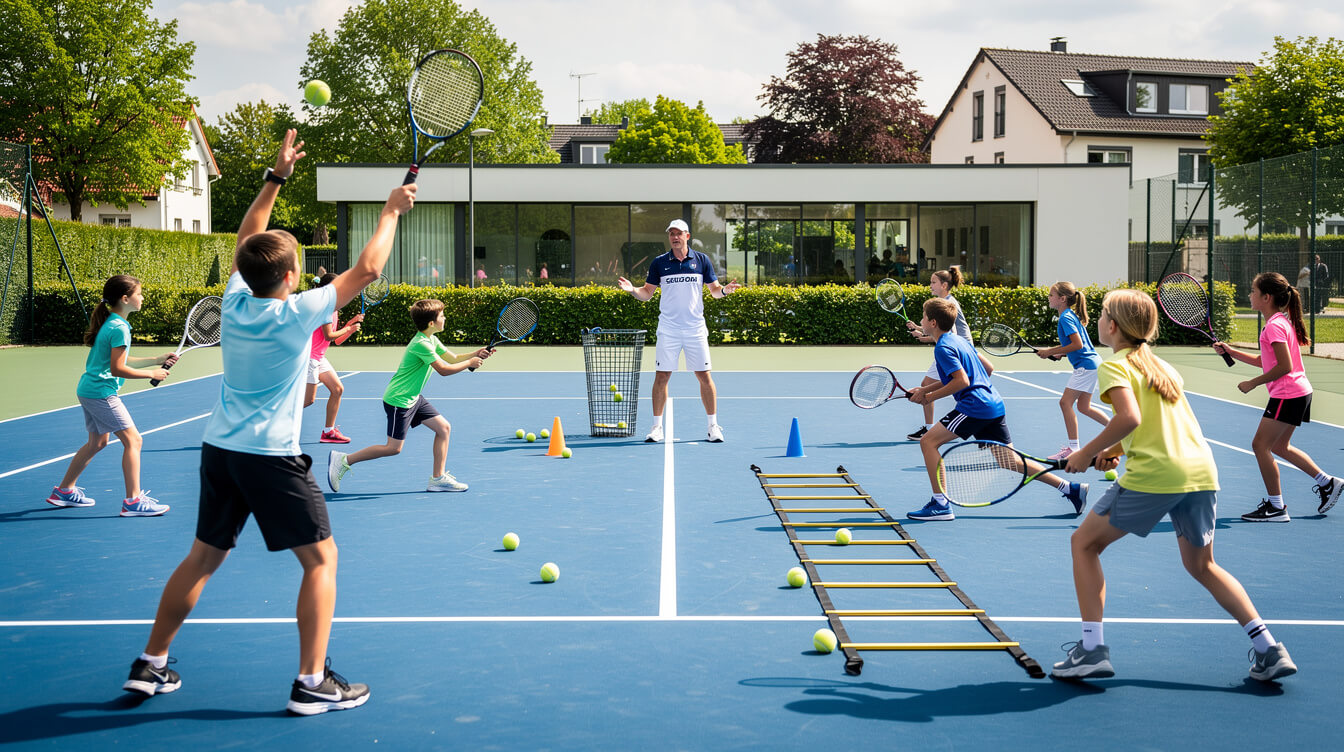
- Program flow: Station training, match plays, skill challenges, breaks with fruit/water.
- Content capture: Photo/video with consent; short interviews, “Best Shot of the Day.”
- Closure & Call-to-Action: Certificates, mini awards ceremony, vouchers for follow-up courses or private lessons.
Small details create a big impact: Music, clear moderation, standardized trainer shirts – and a thank you to sponsors.
Measuring success & follow-up
- Participants vs. registrations (aim for a no-show rate under 10%).
- Conversion to courses/private lessons within 14 days (goal: 30–50%).
- Referrals, social mentions, newsletter sign-ups, CLV growth.
Follow-up: Thank-you email the next day, photo gallery in week 1, offer in week 2, feedback survey in week 3. Use quotes as social proof (remember to obtain consent).
Tools & templates
- Project planning: Google Sheets/Docs, Trello/Asana for tasks and deadlines.
- Design & Social: Canva templates for posters, stories, reels covers.
- Booking & Payment: Online registration tool with waiting list, discount codes, and automated emails.
Checklists to take away
- Before the event: Goals, budget, team, sponsors, landing page, communication, safety.
- During the event: Check-in, schedule, breaks, content, emergency kit, feedback forms.
- After the event: Thank-you email, media, evaluation, offers, retention measures.
Common mistakes and how to avoid them
- Unclear target audience → Segment by age/level and address them appropriately.
- Too late in promotion → 8 weeks lead time with deadlines and countdowns.
- No clear call-to-action → Every communication needs a clear button/link.
- Lack of follow-up → Send at least 2–3 follow-ups with offers and feedback.
Conclusion: With thoughtfully organized tennis school events, you set yourself apart and position your tennis school as the heart of the local tennis community.
FAQ
How early should I start planning a tennis school event?
Ideally, start 8–12 weeks in advance. This gives you enough time for sponsors, trainer planning, registrations, and marketing with at least two reminder waves.
Which event formats deliver the highest conversion to course bookings?
Summer camps often convert the best since participants collect positive experiences over several days. Closely followed by open house days (low entry barrier) and tournaments (strong with ambitious players).
How can I reduce no-shows?
Work with small deposits, send clear advance information (packing list, times, weather), and remind participants 72/24 hours before the event via email or WhatsApp. Offer a waiting list and last-minute replacements.
What content should be on my event’s landing page?
A concise value proposition, program points, target group/level, date/location, price, trainer, frequently asked questions, pictures/videos, and a well-visible registration button. Optionally: Early-bird countdown and testimonials.
What staff and supervision ratio do I need?
Plan for children’s groups about 1 trainer for every 8 participants, for advanced players 1:6. Add helpers for check-in, materials, first aid, and content production.
How do I use the event for long-term retention?
Create a follow-up sequence with a thank-you email, photo gallery, training plan recommendation, and a limited-time offer for courses/private lessons. Ask for feedback and use positive quotes as social proof (with consent).